
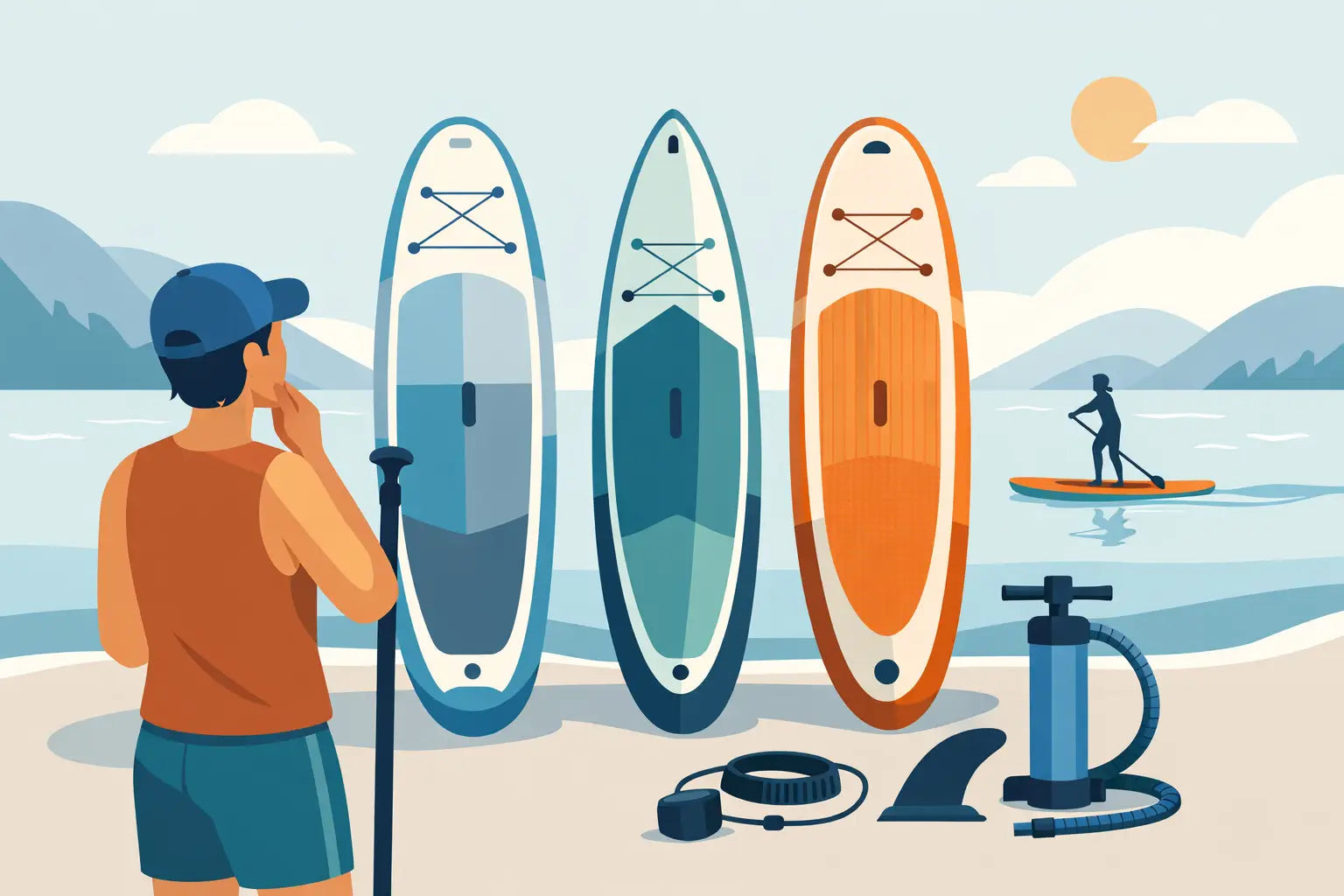
How to Choose a Paddle Board That Fits You
Explore our collection of stand-up paddle boards (SUPs) designed for stability, comfort, and fun on the water. Whether you're paddling calm lakes, exploring rivers, enjoying the coastline, or trying paddle boarding for the first time, Open Air Lifestyles offers trusted brands backed by knowledgeable customer support to help you choose the perfect board for your adventures.
👉 Browse Our Stand-Up Paddle Board Collection
A paddle board that looks great online can feel completely wrong once it hits the water. Too narrow, and it feels shaky. Too short, and it plows instead of gliding. Too specialized, and a relaxing afternoon paddle turns into more work than fun. If you are wondering how to choose a paddle board, the best place to start is not with color or brand. It is with how and where you actually plan to use it.
For most buyers, especially those investing in a quality board they want to enjoy for years, the right choice comes down to fit. Your paddle board should match your body size, comfort level, storage situation, and the kind of water time you want most. That could mean quiet morning paddles on a lake, family outings at the beach, light fitness sessions, fishing, or covering longer distances with more efficiency.
How to choose a paddle board for your style of paddling
Before you compare dimensions or materials, think about your primary use. Not every board is designed to do the same job, and trying to force one board into every role usually leads to compromise.
All-around paddle boards are the most common starting point because they do a little bit of everything. They are typically wider, more stable, and forgiving for beginners or casual paddlers. If your goal is relaxed recreation, family fun, or occasional use on calm water, an all-around board often makes the most sense.
Touring boards are longer and usually narrower, which helps them track straighter and glide farther with each stroke. They are a strong option for paddlers who want to cover distance on lakes, bays, or slower coastal water. The trade-off is that they can feel less stable than a wider all-around shape, especially for beginners.
Surf-style paddle boards are shorter and more maneuverable, built for wave riding rather than flatwater comfort. These are more specialized boards, so they are not usually the best first purchase unless surfing is your main reason for buying.
Fishing paddle boards put stability and deck space first. They are often wider, with room for gear, coolers, and accessories. That added width can be a big advantage if you want a confident platform, but it may feel slower than a more streamlined recreational board.
Yoga and fitness boards also prioritize stability, with generous width and a deck layout that supports movement. If balance exercises or low-impact workouts are part of your outdoor routine, this category is worth a closer look.
Size matters more than most buyers expect
When people ask how to choose a paddle board, size is usually the deciding factor. Length, width, thickness, and volume all affect how the board feels under your feet.
Length influences glide and maneuverability. Shorter boards, generally under 10 feet 6 inches, are easier to turn and easier to handle off the water. Longer boards, especially 11 to 12 feet 6 inches and beyond, move more efficiently and track better in a straight line. If you want easy recreational use, a mid-length all-around board is often a comfortable fit. If you want more speed and distance, a longer touring shape is usually the better tool.
Width affects stability. Many beginners are happiest on boards around 32 to 34 inches wide because they offer a more planted feel. Narrower boards can be faster, but they require more balance and tend to feel less forgiving. If comfort and confidence are your priorities, extra width is rarely a mistake.
Thickness helps determine buoyancy and weight capacity, especially in inflatable models. A thicker board may float a larger paddler more comfortably and keep the deck drier. That said, thickness alone does not tell the whole story. Shape and overall volume matter too.
Weight capacity deserves close attention. Do not shop based only on the listed maximum. A board may technically hold your weight, but it will usually perform better if you stay well under that upper limit. If you plan to bring a child, dog, cooler, or fishing gear, factor that in from the start.
A simple fit rule for most paddlers
If you are new to the sport, choose a board that gives you more stability than you think you need. Most people enjoy paddle boarding more when they feel relaxed, not when they are fighting to stay upright. A board that supports confidence on day one is more likely to get used again and again.
Inflatable vs hard board
This is one of the biggest decisions in the buying process, and it often comes down to lifestyle as much as performance.
Inflatable paddle boards are popular for good reason. They are easier to store, easier to transport, and often a practical choice for homeowners with limited garage space, condo living, RV travel, or boating. Many quality inflatables are impressively rigid once properly inflated and offer plenty of stability for recreational paddling, fitness, and light touring.
Hard boards usually deliver the most direct on-water feel and often the best overall performance in speed, tracking, and responsiveness. If you paddle frequently, have room to store a full-size board, and want the cleanest glide possible, a rigid board can be a great long-term investment.
The trade-off is convenience. Hard boards are bulkier to move, need more storage space, and can be harder to load onto a vehicle. Inflatable boards ask for setup time, but many paddlers find that a fair exchange for easier transport and storage.
For many active adults and retirees, inflatables make ownership simpler. For more performance-focused paddlers with space to store them, hard boards can be especially rewarding.
How to choose a paddle board by water conditions
Where you paddle matters just as much as how you paddle.
On calm lakes and slow-moving waterways, most recreational and touring boards will work well. Stability and comfort usually matter more than specialized performance. On coastal water, bays, or areas with chop, a board with good volume and a stable platform can make the experience much more enjoyable. If you expect wind or boat wake, a board that feels solid underfoot is worth prioritizing.
For ocean surf, you will want a shape built for waves rather than flatwater cruising. For rivers, especially moving water, maneuverability and durability become more important. If your paddling locations vary, an all-around board is often the safest and most versatile choice.
Construction, quality, and long-term value
Not all paddle boards are built to the same standard. This matters more than many first-time buyers realize, particularly if you want dependable performance and warranty-backed peace of mind.
With inflatables, look at the quality of the drop-stitch core, rail construction, and recommended inflation pressure. Better construction usually means better rigidity, better durability, and a more stable ride. With hard boards, materials and manufacturing affect weight, stiffness, and impact resistance.
A cheaper board may save money upfront, but it can also bring frustration if it flexes too much, wears out quickly, or does not perform the way you expected. A premium board from an authorized dealer often gives you better manufacturer support, clearer product guidance, and stronger confidence in what you are buying.
That support matters, especially with higher-ticket outdoor equipment. Being able to talk with a real person, ask questions about fit and use, and know that your purchase is backed by warranty protection can make the entire process easier.
Don’t overlook the full setup
The board is only part of the experience. A good paddle, leash, fin setup, and personal flotation device all affect comfort and safety.
A lightweight paddle can reduce fatigue and make longer outings more enjoyable. A quality fin helps with tracking and control. If you are buying an inflatable package, pay attention to what is included and whether those accessories match the level of paddling you want to do.
This is also where it helps to buy from a retailer that can explain the differences clearly instead of leaving you to sort through dozens of lookalike options on your own. At Open Air Lifestyles, that kind of guidance is part of helping customers choose gear with confidence and ease.
The best paddle board is the one you will use often
It is easy to get pulled toward the fastest board, the lightest board, or the most advanced board. In reality, the best choice is usually the one that fits your real life. It should be comfortable to carry, practical to store, stable enough to enjoy, and capable enough for the kind of water time you want most.
If you are buying your first board, lean toward versatility and stability. If you already know you love longer paddles, fitness sessions, or fishing days on the water, choose a board that supports that next step. And if you are between two options, the board that builds confidence is often the better answer.
A well-chosen paddle board does more than float. It makes it easier to spend more mornings on the lake, more afternoons with family, and more time outdoors feeling active, capable, and relaxed. That is a purchase worth getting right.
%20designed%20for%20stability,%20comfort,%20and%20fun%20on%20the%20water.%20Whether%20you're%20paddling%20calm%20lakes,%20exploring%20rivers,%20enjoying%20the%20coastline,%20or%20tryin...)