A Practical Guide to Trolling Motor Batteries
Explore our collection of marine batteries and chargers designed for dependable trolling-motor performance, longer days on the water, and easier battery management. As an authorized dealer, Open Air Lifestyles offers trusted products backed by knowledgeable customer support to help you match the right battery system to your motor and boat.
👉 Browse Our Marine Batteries and Chargers
A quiet morning on the lake can quickly change when a trolling motor loses power far from the ramp. The right battery setup gives you more than runtime - it gives you the freedom to follow a shoreline, work a fishing spot, or cruise at a relaxed pace without watching the battery meter every few minutes. This guide to trolling motor batteries explains what to buy, how to size your system, and how to protect that investment for many seasons on the water.
Start With Your Trolling Motor Voltage
Your battery bank must match the voltage required by your trolling motor. Most models run on 12, 24, or 36 volts, while a few high-thrust motors require 48 volts. Check the motor's specification label or owner's manual before choosing batteries. A 12-volt battery cannot operate a 24-volt motor by itself, and using the wrong setup can leave you without reliable propulsion.
A 12-volt motor is common on canoes, kayaks, small jon boats, and lightweight fishing boats. It is the simplest arrangement because it uses one battery. A 24-volt motor typically uses two 12-volt batteries wired in series, and a 36-volt motor uses three. Series wiring adds voltage while keeping the amp-hour capacity the same.
For example, two 12-volt, 100 amp-hour batteries connected in series produce 24 volts at 100 amp-hours. Do not confuse that with parallel wiring, which keeps voltage the same but increases available amp-hours. Parallel wiring has useful applications, but it does not create the higher voltage a 24- or 36-volt motor needs.
Amp-Hours Determine How Long You Can Run
Once voltage is settled, amp-hour capacity is the next decision. Amp-hours, shown as Ah, indicate how much energy a battery can store. In general, a higher Ah rating means longer runtime, though actual performance depends on motor speed, wind, current, boat weight, prop condition, and water conditions.
A simple planning estimate is to divide battery amp-hours by the motor's average amp draw. If a 100Ah battery supports a motor drawing an average of 20 amps, the theoretical result is about five hours. Real-world runtime will be lower because batteries should not always be discharged completely, and motors rarely operate under laboratory conditions.
Trolling motors use the most power at high speed. Running at a moderate setting can extend a day on the water far more than many boaters expect. If you regularly fish windy reservoirs, push a loaded pontoon, or spend long days away from shore power, choose more capacity than the minimum specification suggests.
A Useful Capacity Rule
For many 12-volt applications, a 100Ah deep-cycle battery is a strong starting point. Larger boats and longer outings may call for 125Ah or more, provided the battery size and weight fit the available compartment. For 24- and 36-volt systems, each battery in the series bank should generally have the same voltage, chemistry, capacity, age, and model.
Mixing an older battery with a new one can weaken the entire bank. The system performs only as well as its least healthy battery, so replacing a matched set together is often the wiser long-term choice.
Choose the Right Battery Chemistry
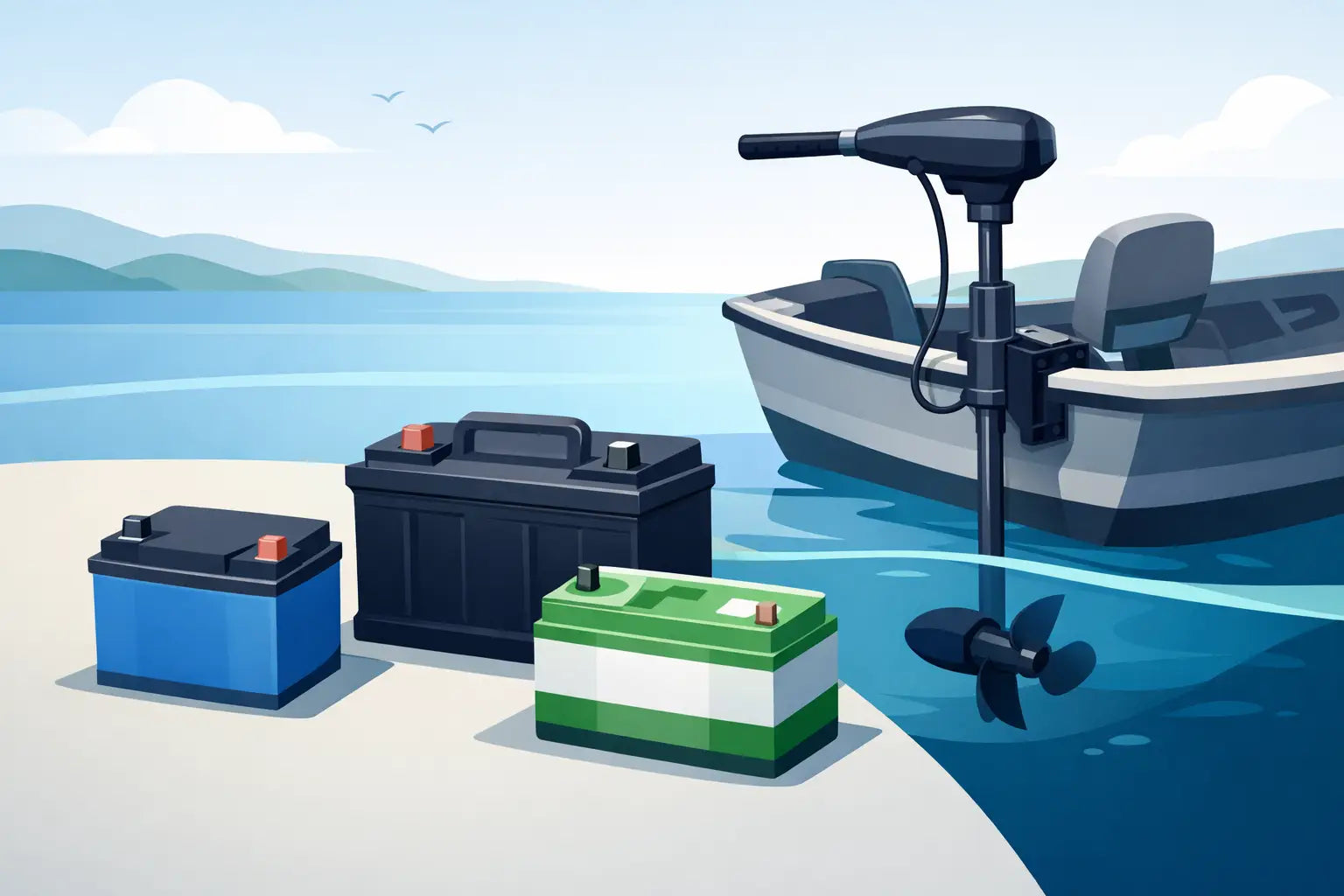
There are three common choices for trolling motor use: flooded lead-acid, AGM, and lithium iron phosphate, often called LiFePO4. Each can be the right answer depending on your boat, budget, storage situation, and desired convenience.
Flooded lead-acid deep-cycle batteries are familiar and usually have the lowest upfront cost. They can provide dependable service when properly maintained, but they are heavy, need ventilation, and require periodic water-level checks. They also should remain upright to prevent spills. They suit boaters who use their setup regularly and are comfortable with hands-on maintenance.
AGM batteries are sealed lead-acid batteries. They are spill-resistant, maintenance-free, and typically tolerate vibration better than traditional flooded batteries. They remain heavy, but they are a practical option for owners who want proven performance without checking water levels. AGM is often a sensible middle ground for fishing boats and pontoons where battery weight is manageable.
Lithium LiFePO4 batteries cost more at purchase, yet they offer compelling advantages: far less weight, deeper usable capacity, fast charging, and long cycle life. Reducing battery weight can noticeably improve a kayak, small boat, or stern-heavy rig. Many lithium batteries also include a battery management system that helps protect against overcharging, over-discharging, and temperature issues.
Lithium is not automatically the best fit for every boat. Confirm that the battery is rated for trolling motor use, has sufficient continuous discharge capability, and works with your charger. Cold-weather charging restrictions also matter. Many lithium batteries should not be charged below freezing unless they have built-in low-temperature protection or heating.
Battery Size and Weight Matter on the Boat
Before ordering, measure the battery tray, compartment opening, and clearance around cables and hold-down straps. A battery may fit on paper but be difficult to install through a narrow hatch. Group 24, Group 27, and Group 31 are familiar lead-acid case sizes, with larger groups generally offering more reserve capacity and weight.
Weight deserves equal attention. A large lead-acid battery can weigh 50 to 75 pounds, and a multi-battery bank adds up quickly. That weight affects trim, trailer loading, and how easily you can prepare the boat at home. Lithium can make transportation and installation easier, especially for active adults who want to spend their energy enjoying the water rather than wrestling gear.
Secure every battery in an appropriate tray or bracket. Rough water and trailer travel can turn an unsecured battery into a safety hazard, even when the boat is only used occasionally.
Charging Is Part of Battery Life
A quality charger is as valuable as the battery itself. Select a marine charger designed for your battery chemistry and voltage bank. For a 24-volt system made from two 12-volt batteries, a two-bank onboard charger is often the most convenient option because it charges each battery independently.
Charge batteries as soon as practical after an outing. Leaving a lead-acid battery partially discharged for extended periods encourages sulfation, which permanently reduces capacity. Lithium batteries are more forgiving, but routine recharging still helps ensure the boat is ready for the next trip.
Use the charger manufacturer's recommended settings. A charger built only for flooded lead-acid batteries may not be suitable for AGM or lithium batteries. Smart chargers can reduce the risk of overcharging by switching to a maintenance mode when charging is complete, but they still need the correct chemistry setting.
During seasonal storage, disconnect accessories that create small but constant power draws. Store batteries in a dry, moderate-temperature location when possible, and inspect terminals before returning to the water. Keep connections clean, tight, and protected from corrosion with marine-rated terminal protectant.
Avoid the Most Common Setup Mistakes
A trolling motor needs a true deep-cycle battery, not simply a car's starting battery. Starting batteries are designed to deliver a short, powerful burst to crank an engine. Deep-cycle batteries are built to provide steady power over a longer period and recover through repeated charging cycles.
Also avoid undersized cables, loose terminals, and improvised wiring. Voltage drop can reduce motor performance and create heat at connections. Follow the motor manufacturer's cable gauge, fuse, circuit breaker, and wiring recommendations. A properly sized manual-reset breaker, located close to the battery, helps protect the wiring and motor.
If your boat also has an engine starting battery and electronics, keep the trolling motor bank separate unless the system is specifically designed to combine them. Dedicated propulsion batteries prevent a long day of trolling from leaving too little power to start the outboard.
Build a Battery Setup Around Your Day on the Water
Think about the outings you actually take. A kayak angler making short trips on protected water may value a compact, lightweight lithium battery. A bass boat owner covering long distances with a high-thrust 36-volt motor may prioritize a matched, high-capacity bank and dependable onboard charging. A pontoon owner may prefer the easy maintenance of AGM batteries and the reassurance of extra reserve capacity.
The best choice is rarely the cheapest battery on the shelf. It is the system that matches your motor, fits your boat, supports your typical runtime, and can be charged and maintained without unnecessary hassle. When comparing premium marine equipment, Open Air Lifestyles can help you evaluate those practical details with real customer support before and after the sale.
A well-chosen battery bank lets the trolling motor fade into the background, which is exactly the point. You can focus on the next cast, the quiet cove, or the people sharing the boat with you - and keep living your best outdoor life with confidence and ease.