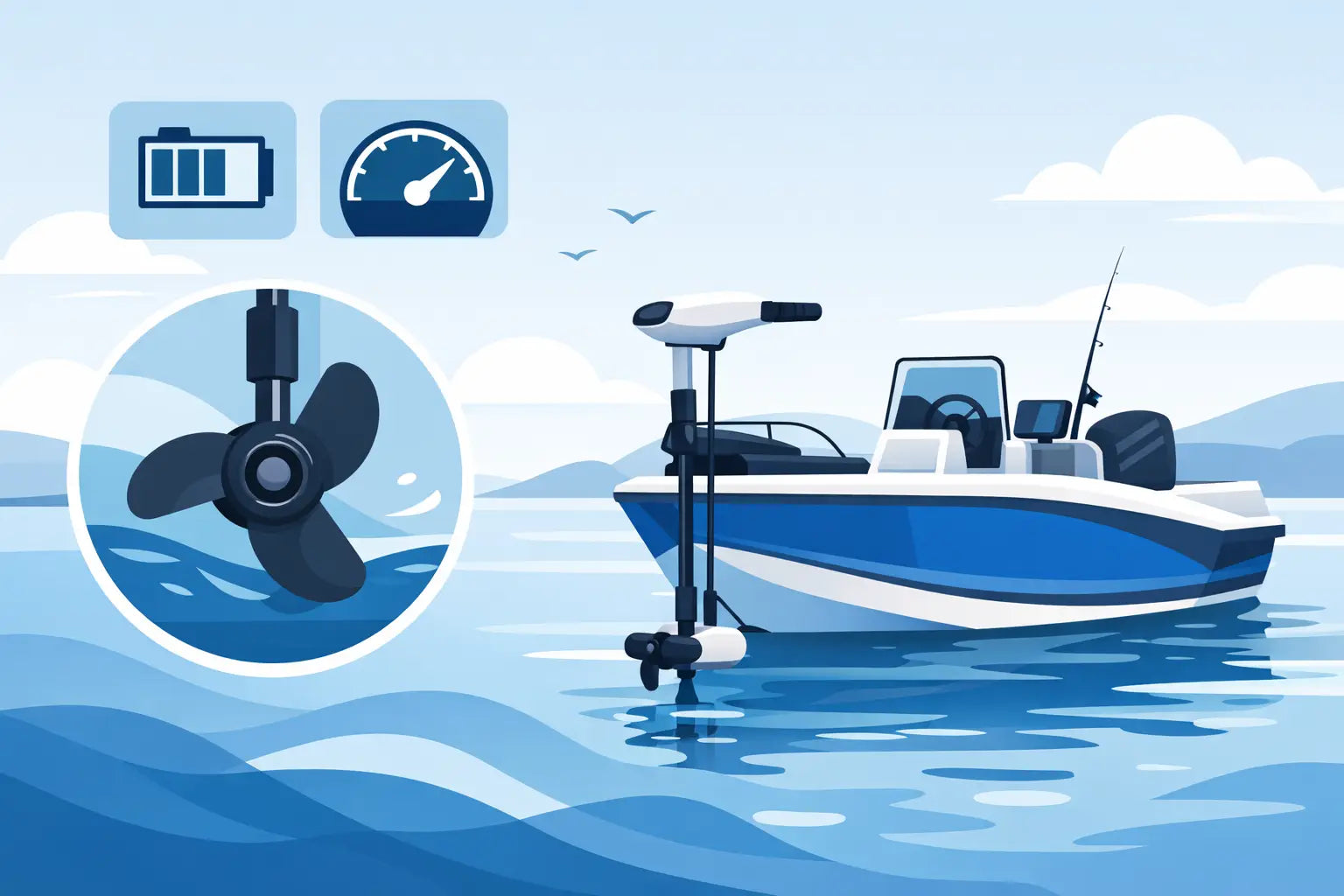
Trolling Motors for the Right Power on Your Boat
Explore our collection of trolling motors and electric propulsion options designed for easier boat control, quiet cruising, and more enjoyable days on the water. Compare power, mounting styles, and features to find the setup that fits your boat and the way you use it.
👉 Browse Our Trolling Motors Collection
The fish are holding along a quiet shoreline, and the last thing you want is an engine that spooks them or makes boat control feel like work. The right trolling motors give you calm, precise movement when casting, positioning over structure, working a dock line, or simply enjoying an unhurried morning on the lake.
For many boaters, a trolling motor becomes one of the most-used pieces of equipment on board. It can make a fishing trip more productive, help a pontoon ease into position, and add confidence when wind or current complicates the day. The key is not choosing the biggest model available. It is choosing a motor with the right thrust, shaft length, battery setup, and controls for your boat and how you spend time on the water.
Start With How You Use Your Boat
A quiet electric motor is valuable for far more than tournament anglers. Kayak anglers may need a compact unit that extends range without taking up valuable deck space. Bass boat owners often want a bow-mounted motor with responsive steering and GPS-assisted positioning. On a jon boat, skiff, or small pontoon, a transom-mounted motor may provide simple, dependable control for fishing and relaxed cruising.
Think about where you boat most often. Protected ponds and small inland lakes place different demands on equipment than broad reservoirs, tidal rivers, or coastal bays. Wind, current, boat load, and hull shape all affect how much power you need. A motor that feels excellent on a calm morning can feel underpowered when an afternoon breeze picks up and the boat is carrying several passengers, a cooler, and fishing gear.
Also consider whether the trolling motor is your primary means of propulsion or a positioning tool used alongside an outboard. A primary electric setup calls for more attention to battery capacity and realistic range. If the motor is mainly for quietly approaching fish or holding your boat in place, control features and mounting location may matter most.
How Much Thrust Do Trolling Motors Need?
Thrust is the pulling force of an electric motor, measured in pounds. It is not a direct equivalent to gasoline-engine horsepower, and more thrust does not automatically mean a faster boat. What extra thrust does provide is better authority over the boat when wind, current, or a heavier load works against you.
As a general starting point, many boaters use roughly 2 pounds of thrust for every 100 pounds of fully loaded boat weight. That loaded weight should include the hull, motor, fuel, batteries, passengers, gear, and typical supplies. For a 3,000-pound loaded boat, a motor around 60 pounds of thrust may be a reasonable baseline. Conditions may justify moving up.
Choosing a little more thrust than the minimum can be wise for larger boats or exposed water. You may not run at full power often, but a motor operating comfortably below its limit can improve control and preserve battery life. The trade-off is that higher-thrust models often require a larger battery system, add weight, and cost more.
Voltage is closely tied to thrust. Smaller motors commonly run on 12-volt systems, while more powerful models may require 24 or 36 volts. A 12-volt setup can be straightforward for a lightweight boat, but it has practical limits. Before selecting a motor, make sure your boat has room for the required batteries and that the added weight will not affect trim or performance.
A practical way to size power
Instead of buying based on boat length alone, start with loaded weight and boating conditions. Then ask whether you regularly fish windy open water, carry multiple people, or use the motor for long periods. If the answer is yes, choosing additional thrust is often the more comfortable choice. If your boat is light, your water is sheltered, and you use the motor occasionally, a smaller system may be all you need.
Shaft Length Is About Keeping the Propeller in the Water
A powerful motor with the wrong shaft length can be frustrating. If the shaft is too short, the propeller may break the surface in waves or when weight shifts in the boat. That causes lost thrust, noisy cavitation, and reduced control. If it is excessively long, the lower unit can be more vulnerable in shallow water and may be awkward to stow.
Measure from the mounting point down to the waterline, then account for the conditions you expect. Bow-mounted motors on bass boats, pontoons, and deep-V boats often need different shaft lengths because their decks sit at different heights above the water. Boats used on choppy lakes may benefit from extra shaft length to keep the propeller submerged when the bow rises and falls.
For transom-mounted models, measure from the transom mounting surface to the waterline. If you are between sizes, consider the water you actually run. A modestly longer shaft is usually the safer choice for boats that see waves, while a shorter shaft can be practical for shallow, calm-water applications.
Choose Controls That Make Time on the Water Easier
The basic choice is hand control, foot control, or remote control. Each has a place, and the best fit depends on how you operate the boat.
Hand-controlled motors are familiar, direct, and often well suited to small boats, canoes, kayaks, and transom applications. They are simple to use when you are seated near the motor. Foot controls are popular with anglers who want both hands free for casting while making constant, subtle steering adjustments from the bow.
Remote-controlled models can be especially appealing for boaters who value comfort and flexibility. Depending on the system, a remote may let you steer, adjust speed, deploy features, or manage GPS functions from different places in the boat. This can be useful on pontoons and fishing boats where you may move between seats throughout the day.
GPS-enabled features deserve careful consideration. Spot-lock or anchor-style positioning can hold a boat near a selected location without dropping a physical anchor. Route recording and heading control can help maintain a course along a shoreline, weed edge, or contour. These features are convenient, particularly for anglers, but they add cost and depend on good battery capacity and proper setup. They are best viewed as useful tools, not replacements for watching changing wind, traffic, and water conditions.
Battery Capacity Shapes Your Day
A trolling motor is only as useful as the energy available to run it. Battery runtime depends on battery capacity, motor speed, voltage, boat load, water conditions, and how frequently you use the motor at higher power. There is no single runtime figure that applies to every boat.
Lithium batteries are increasingly popular because they can reduce weight and often provide strong usable capacity. They typically cost more up front and should be paired with compatible charging equipment. Quality AGM or flooded lead-acid deep-cycle batteries remain practical options for many boaters, though they are heavier and may provide less usable capacity for the weight they add.
Whatever chemistry you choose, use true deep-cycle marine batteries sized for your motor's voltage requirements. Follow the motor and battery manufacturers' guidance for wiring, fuses or circuit breakers, and chargers. A properly installed system is safer, performs better, and helps protect the investment you have made in your boat.
Plan charging around the way you boat. If your usual outing lasts a few hours close to home, a well-maintained battery bank may be plenty. If you take full-day trips, travel to remote launch sites, or rely on electric propulsion for extended runs, reserve capacity becomes much more important. It is far more enjoyable to return to the ramp with battery power to spare than to spend the final hour carefully rationing it.
Mounting and Water Conditions Matter
Bow-mounted motors provide excellent boat control because they pull the boat from the front. This is why they are a common choice for dedicated fishing boats. They can track along a bank smoothly and make fine adjustments while you cast ahead of the boat.
Transom-mounted motors push from the rear and are often easier to install and transfer between boats. They are a strong fit for small aluminum boats, inflatables, canoes, kayaks, and as auxiliary propulsion on certain boats. Their simplicity is part of their appeal, although they may not offer the same hands-free control or integrated GPS options as premium bow-mounted systems.
Freshwater and saltwater use also affect the choice. Motors intended for saltwater typically use corrosion-resistant materials and protective coatings designed for marine exposure. Even so, rinse the motor with fresh water after use, inspect connections regularly, and follow the manufacturer's maintenance guidance. Saltwater is demanding on every piece of equipment, not just the motor.
Buy for Confidence Beyond the First Launch
A trolling motor is a long-term piece of boating equipment, so support matters. Confirm that the motor is appropriate for your hull, battery bank, intended water, and mounting location before ordering. It is also worth considering warranty coverage, replacement-part availability, and whether knowledgeable help is available if an installation or setup question comes up.
Open Air Lifestyles helps boaters compare premium marine equipment with real customer support before and after the sale. Buying from an authorized dealer gives you greater confidence that the product is backed by manufacturer warranty protection and that you have a helpful resource when you need practical guidance.
The best motor is the one that makes your boat feel easier to use. When thrust, shaft length, controls, and battery capacity work together, you can spend less time correcting course and more time enjoying the quiet places that brought you onto the water in the first place.