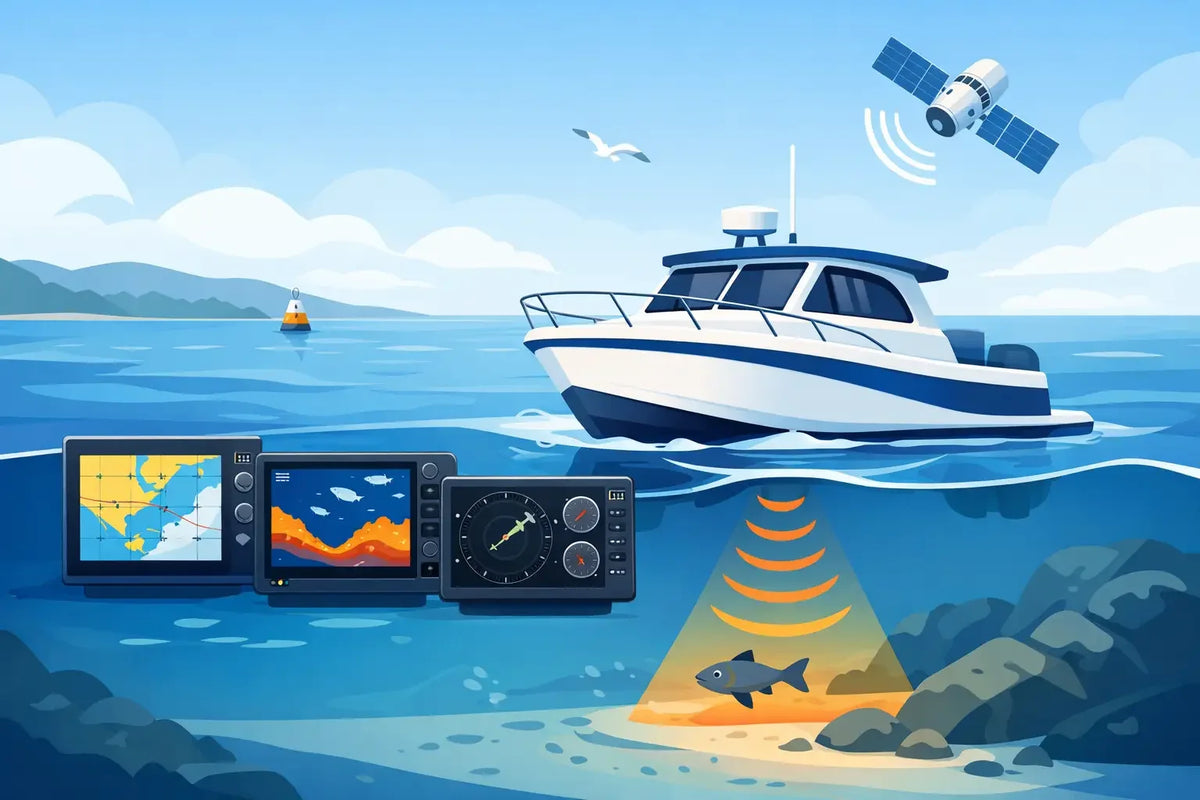
How to Pick Marine Electronics for Your Boat
Explore marine electronics designed to make navigation, fishing, and time on the water easier and more enjoyable. Compare GPS chartplotters, fish finders, sonar, and other boating technology to build a setup that fits your boat and the way you use it.
👉 Explore Our Marine Electronics
A great day on the water can turn frustrating quickly when you cannot read the channel, find the fish, monitor your engine, or communicate clearly in an emergency. Learning how to pick marine electronics starts with a simple question: what information do you need at the helm to boat with more confidence and ease?
The right setup is not necessarily the largest screen or the most expensive package. It is the equipment that suits your boat, the waters you use, and the way you spend time outside. A weekend cruiser on a familiar lake has different needs than an offshore angler, a coastal boater, or a family exploring new waterways.
How to Pick Marine Electronics Around Your Boating Style
Before comparing brands, screen sizes, or feature lists, think about the trips you actually take. Consider where you boat most often, how far you travel from shore, whether you fish, how many people are typically aboard, and how comfortable you are with technology.
For many recreational boaters, a dependable GPS chartplotter with clear mapping is the natural starting point. It shows your position, helps you follow a route, and makes it easier to identify channels, hazards, ramps, marinas, and points of interest. If you fish, adding sonar or a fish finder can be a meaningful upgrade. If you boat in busy coastal areas, on large lakes, or offshore, radar and VHF communication deserve closer attention.
Try to avoid buying electronics based only on the occasional trip you hope to take someday. Choose for your normal use first, then leave room to expand if your boating plans change. That approach protects your budget while ensuring the equipment gets used regularly.
Start With the Most Useful Core Equipment
Marine electronics work best as a purposeful system rather than a collection of unrelated gadgets. For most boats, the core system begins with navigation and grows according to the vessel and activity.
GPS Chartplotter and Marine Charts
A chartplotter combines GPS positioning with electronic marine charts. It is often the most valuable display at the helm because it brings navigation information into one easy-to-view place. Screen size matters, but readability matters more. A seven-inch display may be perfectly comfortable on a small center console, while a larger helm or cabin cruiser may benefit from nine, 12, or more inches.
Look at the screen in relation to your seating position and windshield. Bright sunlight, polarized sunglasses, spray, and vibration can make a marginally sized display harder to use than expected. Touchscreen controls are intuitive, while physical buttons can be easier to operate in rough water or with wet hands. Many boaters appreciate having both.
Also pay attention to chart coverage and update options. Detailed maps of your local lake, river system, coastline, or fishing area are not an extra. They are central to the value of the unit.
Sonar and Fish Finders
Sonar is essential for many anglers, but it can also help any boater understand water depth and bottom conditions. Basic sonar displays depth and bottom contour. More advanced systems may offer traditional CHIRP sonar, down imaging, side imaging, and live sonar views.
The best choice depends on how you fish. A casual angler may be well served by reliable depth readings and traditional sonar. Anglers who target structure, work shallow water, or spend serious time locating fish may find side imaging or live sonar worthwhile. These features can be impressive, but they also require the right transducer, clean installation, and time on the water to learn.
Do not overlook transducer compatibility. A display can only perform as well as the transducer feeding it information. Hull material, boat speed, mounting location, and whether your boat is trailered all affect the right choice.
VHF Radio and Emergency Communication
Cell phones are useful, but they are not a substitute for a fixed-mount VHF radio when boating beyond dependable cell coverage or in areas with active marine traffic. VHF radios allow communication with other vessels, marinas, bridges, locks, and emergency services.
A radio equipped with Digital Selective Calling can send distress information more effectively when properly connected to your GPS. For coastal boaters, offshore anglers, and anyone who regularly ventures into remote water, this is a practical safety investment. Handheld VHF radios are convenient as backups or for smaller boats, but a fixed unit with a quality antenna generally provides better range.
Radar, AIS, and Cameras
Radar is not necessary for every recreational boat, yet it can be extremely valuable for boaters who run in fog, darkness, rain, or congested waterways. It helps identify land, storms, vessels, and navigation markers beyond what you can see clearly from the helm. It also takes practice. Buying radar without committing to learn its operation limits its benefit.
AIS, or Automatic Identification System, can display the location and movement of equipped commercial and recreational vessels. It is especially useful around shipping lanes and coastal traffic. A helm or backup camera can also make docking, trailer loading, and monitoring blind areas more comfortable. These are convenience features for some owners and confidence-building tools for others.
Choose a Display Size That Works at the Helm
Bigger is not automatically better. An oversized display may crowd gauges, obstruct sightlines, or be difficult to protect on a small open boat. A screen that is too small, however, encourages you to zoom in and out constantly or look away from the water longer than necessary.
Measure the usable dash area before ordering. Account for mounting brackets, wiring behind the panel, access to controls, and the angle of the display. If more than one person may use the boat, position the unit where the operator can see it without stretching or turning away from the bow.
For a multi-function display that will handle charts, sonar, engine data, radar, and cameras, a larger screen often makes sense because several data windows can appear at once. On a compact fishing boat, separate smaller units may sometimes be easier to arrange and less costly to replace later.
Think About Networking Before You Buy
Networking is where a well-planned marine electronics package becomes easier to live with. Compatible units can share GPS data, sonar, engine information, radar, autopilot controls, and waypoints through marine networking standards such as NMEA 2000 and manufacturer-specific networks.
You do not need to become a network engineer to make a good decision. You do need to ask whether the equipment you choose can communicate with the accessories you may add later. If you expect to add a trolling motor, autopilot, additional display, engine monitoring, or radar, choosing compatible products from the start can prevent expensive workarounds.
Staying within one ecosystem can simplify setup and support, though it is not the only path. The trade-off is that a single-brand system may offer smoother integration, while a mixed system can sometimes let you select a preferred specialty component. Confirm compatibility before purchasing, not after equipment is mounted.
Do Not Treat Installation as an Afterthought
Marine electronics face vibration, heat, UV exposure, humidity, salt spray, and changing electrical loads. Proper installation matters as much as the model you select. A poorly placed transducer, undersized power wire, weak antenna connection, or exposed connector can cause inconsistent performance that looks like a product problem.
Small, straightforward installations may be manageable for experienced do-it-yourself boat owners. More complex systems involving radar, integrated engine data, multiple displays, autopilot, or through-hull transducers are often better handled by a qualified marine installer. Professional rigging can protect your boat, preserve warranties, and make future service much easier.
Ask how the unit will be mounted, where wiring will run, how the circuit will be protected, and whether the installation leaves access for maintenance. On an older boat, it is also wise to assess battery condition and charging capacity before adding several power-hungry devices.
Balance Features With Long-Term Support
Marine electronics are a higher-ticket purchase, and the lowest price is not always the lowest cost over time. Consider manufacturer warranty coverage, update availability, replacement parts, customer support, and whether you can get knowledgeable help if a setting, connection, or installation question arises.
Buying from an authorized dealer adds reassurance that the product is legitimate, warranty-backed, and supported through the proper channels. At Open Air Lifestyles, real customer support helps boaters sort through practical questions before and after a purchase, so the decision is based on fit rather than guesswork.
It also helps to plan a realistic budget for the complete project. Include charts, transducers, antennas, mounts, network components, batteries or electrical upgrades, protective covers, and installation. A well-chosen midrange system that is properly installed and easy to use will usually bring more enjoyment than a feature-packed setup that never gets fully configured.
The best marine electronics should let you spend less time second-guessing the helm and more time enjoying the trip. Choose equipment you can read, understand, and trust, then give yourself a little time to learn it close to home before heading farther out. That is how technology becomes a welcome part of living your best outdoor life on the water.